Duklja (Doclea) — The Roman City Five Kilometres from Your Runway

A 2,000-year-old Roman colonia at the confluence of the Morača and Zeta rivers — the most overlooked archaeological site in Montenegro, fifteen minutes from TGD

The ruins most arrivals never notice

When your plane banks on final approach into Podgorica Airport from the north, somewhere below your left wing is a flat rocky terrace wedged between two rivers — the Morača and the Zeta — scattered with low stone foundations, stubs of wall, and a half-dozen informal footpaths worn into the grass. That is Duklja. In Latin it was Doclea, a Roman colonia founded in the late 1st century AD, and at its height the largest city in this part of Illyria. Almost nobody flying into TGD knows it is there. It is 10 km from the runway, 15 minutes of driving, and most of the year you will share it with two or three archaeology students and a flock of sheep.

This post is the one I wish someone had handed me the first time I cleared customs at TGD. If everything about the airport itself is still fresh — ATM, SIM, rental barrier — the first-hour TGD arrivals guide is the prerequisite; this is what to do once you are rolling.

What Doclea was

Doclea was founded during the reign of the emperor Vespasian (ruled 69–79 AD), on a natural defensive terrace where the Zeta joins the Morača, about 3 km north of where central Podgorica now sits. The site had been occupied earlier by the Illyrian Docleatae tribe — the Romans kept the name and Latinised it. It was granted municipium status under Vespasian and later became a full Roman colonia, meaning discharged veterans received land grants there.

At its 2nd- and 3rd-century peak the population was around 10,000, the main decumanus ran roughly 500 metres east–west through a walled enceinte of about 25 hectares, and the city had everything a provincial Roman capital required: forum, basilica, temples (to Diana and to Roma), thermal baths, an aqueduct from the Cijevna spring, and an amphitheatre outside the walls. It was the administrative centre of the Roman province of Praevalitana from the late 3rd century onward.

Why you have never heard of it

Three reasons. First, Doclea was finished off by a major earthquake in 518 AD and never properly rebuilt; the survivors drifted south and eventually founded a settlement that became Podgorica. Second, the site was then quarried for stone for over a thousand years — medieval Podgorica, Ottoman Podgorica, and 19th-century Podgorica all took dressed stone from Doclea, which is why the walls standing today are mostly a metre or two tall. Third, it is unfenced, unticketed, unsignposted beyond a single brown board, and does not appear on most guidebook shortlists. The archaeological finds — coins, inscriptions, the statues that have been lifted out of the forum — are in the Archaeological Museum in the centre of Podgorica.

The name is the other reason it matters. The medieval Slavic principality that emerged in this area in the 10th–11th centuries was called Duklja, after the ruins. Duklja in turn was a direct predecessor of the later medieval Zeta, which was a predecessor of modern Montenegro. The word Doclea / Duklja is woven through a thousand years of local identity. Some etymological theories (disputed) even trace Montenegrin itself back to a linguistic ancestor found here.

How to get there from TGD

Head out of the airport on Golubovci road toward Podgorica. Continue onto the M2 and then onto the western Podgorica bypass — the same road you would take to Ostrog Monastery, which is handy because both head north from TGD and Doclea is essentially a stop on the way. About 4 km past central Podgorica, watch for signs to Rogami and a single brown Duklja / Doclea marker pointing right off the main road.

Follow the turnoff for about 1.5 km on a narrow but paved lane, past small houses and market gardens, until the road opens onto the terrace. There is no car park — you park on the verge. There is no ticket office, no gift shop, no guard. The site is simply there. Total drive from TGD: 10–12 km, 15–20 minutes depending on Podgorica bypass traffic.

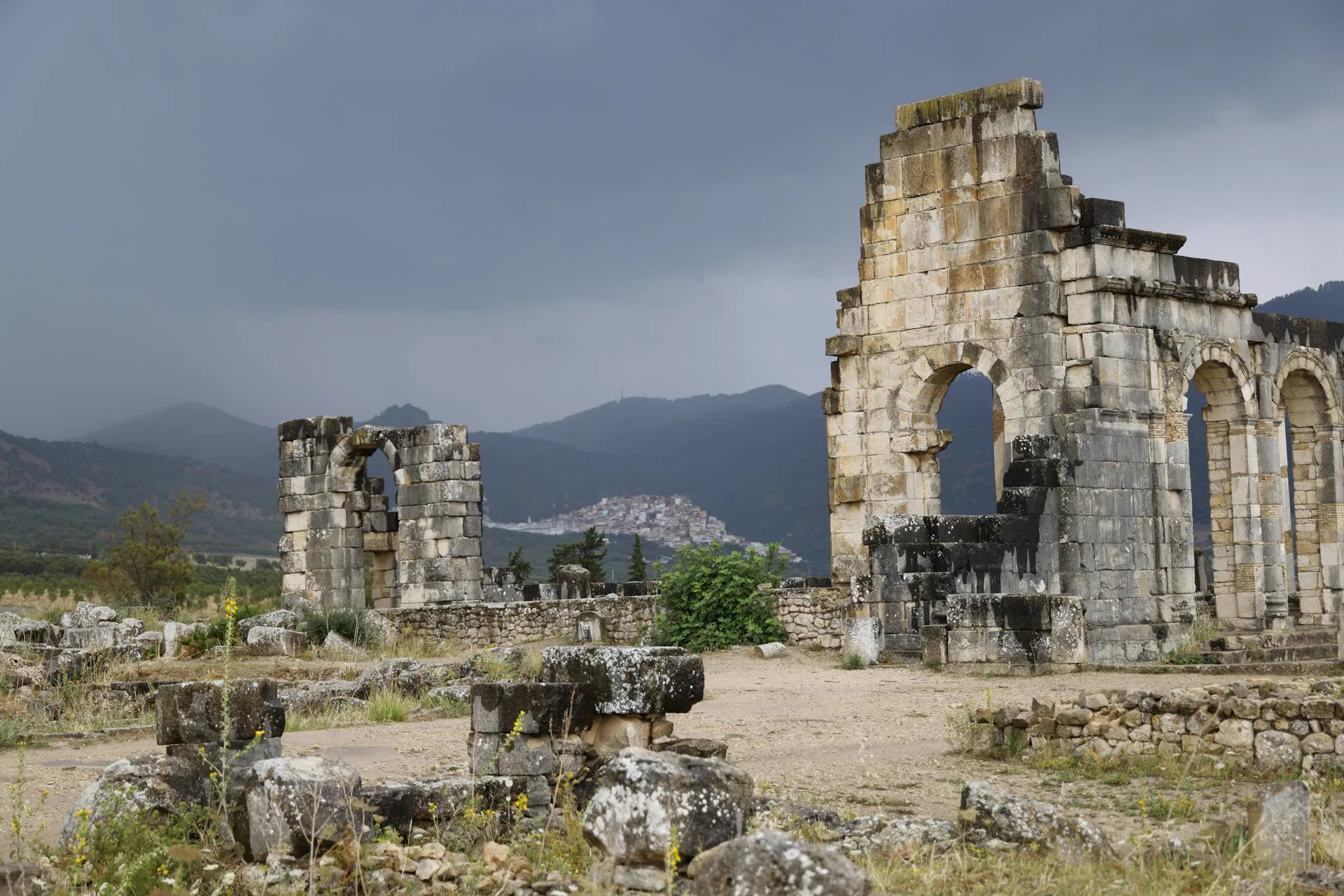
Duklja (Doclea) Roman ruins with the stone walls and forum foundations on a rocky terrace near Podgorica

What you actually see on site

Walking the site takes between 60 and 90 minutes at an unhurried pace. There is no fixed route; paths are worn informally through the grass. The four things to look for:

  • The city wall — the best-preserved stretch runs along the southern edge of the terrace above the Morača. Courses of dressed limestone up to two metres tall, with the outline of towers visible.
  • The forum — a rectangular paved platform roughly 30 × 50 m, with column bases still in situ on three sides. The basilica foundation sits on the east edge. This is the centre of the site and where most of the inscriptions were recovered.
  • The thermal baths (thermae) — clearly identifiable hypocaust pillars (the short stacked-brick columns that supported the heated floor) in the north-west quarter. You can walk directly into what was the caldarium.
  • The necropolis — outside the walls to the east, a scatter of stone sarcophagi and grave markers, some still with visible Latin inscriptions. Do not move anything; the site is officially protected even though it looks wild.

There is also a ruined early-Christian basilica on the south side, dating to the 4th or 5th century, marking the short window between Doclea's conversion to Christianity and its destruction.

Best time of day

Morning light, up to about 10:00, is the best for photographs — the low sun picks out the wall courses and the forum pavement. Late afternoon, from roughly 17:00 in summer, does the same thing from the opposite direction and has the added benefit of cooler temperatures. Midday in July and August is punishing: the site has no shade to speak of, the stone radiates heat, and the Zeta plain routinely hits 38°C. Bring water — at least a litre each — because there is nothing on site and nothing within walking distance. A hat is not optional.

Winter is actually a pleasant time to visit: mild (10–15°C), the grass is green rather than burnt yellow, and the site is entirely empty. Avoid the day after heavy rain — parts of the terrace drain slowly and you will be walking through mud.

Combining with other drives

Doclea combines beautifully with any onward drive north. The Rogami turnoff is only a few kilometres off the E80, so you can stop for an hour on the way up to Ostrog or to Durmitor and lose almost no time from your main itinerary. Of the two, the Ostrog drive is the tidier pairing — same direction, same day, two religious complexes separated by 1,700 years. The Žabljak and Durmitor drive is better done as a dedicated full day, so Doclea pairs with it only if you are doing an unhurried return on day two.

The Archaeological Museum (Muzeji i galerije Podgorice) on Marka Miljanova street in central Podgorica is the other half of the Doclea visit — it holds the mosaic fragments, the carved stelae, the bronze Diana statuette, and the coin hoards that have been lifted off the site over the last century. Forty minutes inside the museum makes the outdoor site three times more legible. Entry is a few euros, closed Mondays.

Why it is worth the detour

Montenegro is a country of obvious postcards — Kotor, Ostrog, Durmitor, Sveti Stefan — and it is easy to drive past the less photogenic things on the way to them. Doclea is the counter-argument. It is the reason Podgorica exists. It is the origin of a name that echoes through a thousand years of Balkan history. It is five minutes off your route north. And you will, in all likelihood, have it almost entirely to yourself.

At a glance

Distance from TGD~10 km
Drive time15–20 min
FoundedLate 1st c. AD (under Vespasian)
Site area~25 ha
DestroyedEarthquake, 518 AD
EntryFree, unfenced, no facilities

Ready to drive the Podgorica region?

Search Cars